In-house development means freedom at a price
For Information Systems Departments (ISDs), the temptation to develop a solution in-house may seem rational. At least in theory, it gives them complete control over architecture, code, data, IS integration, business logic and user paths. In-house development can also be reassuring when it comes to data sovereignty or advanced personalization, but this freedom comes at a cost, and that cost far exceeds the initial investment. In practice, making appointments hides a functional complexity that is far greater than it seems :
- Management of multiple resources (agents, agencies, call center agents, etc.)
- Dynamic, customizable availability rulesIntelligent notifications (e-mails, SMS, reminders messages)
- Multi-profile user interfaces (customers, employees, supervisors)
- Connectors with CRM, ERP, telephony tools, video systems
- Rules engine, rights management, global and local settings
- RGPD compliance, accessibility, auditabilityAnalytical reporting and data exporting
Each new feature requires design time, development, testing, documentation, maintenance and support resources. What starts out as a controlled project quickly becomes a fully-fledged product to be maintained over time. Not to mention the difficulty of recruiting and retaining talent capable of supporting this type of project over the long term.
The reality of total cost of ownership (TCO)
If you add up the internal efforts (technical, business, support), the total cost of ownership (TCO) of an in-house solution can be much higher than that of a market solution. Not to mention the time it takes to deploy an in-house solution, which can take several months or even over a year in large organizations. At a time when business needs are evolving rapidly, and customers expect simple, fluid processes, this delay can be a strategic obstacle.
Another pitfall is technical debt. In the absence of a structured roadmap, complete documentation or long-term resources, many in-house solutions quickly become inflexible, difficult to evolve or dependent on a few key developers.
Why more and more companies are turning to SaaS
Conversely, SaaS platforms dedicated to appointment scheduling offer immediate access to mature technology bricks designed to meet the most complex use cases. These solutions natively integrate UX best practices, security, regulatory compliance, management tools, scalability and API connectors for interfacing with existing systems. They enable :
- Reduce time-to-market, with commissioning possible in a matter of weeks
- Free up internal resources for higher value-added projects
- Guarantee ongoing scalability (updates, new features)
- Benefit from expert support that is often difficult to match in-house
- Simplify cost management with a predictable subscription model
Some platforms go even further (such as Agendize), integrating advanced functions such as omnichannel orchestration (appointment scheduling from a website, app, call center, chatbot, etc.), multisite management, or detailed analysis of flows and performance.
What IT and business decision-makers are looking for
Today, CIOs, customer experience managers and customer relationship managers are all looking for a solution that is reliable, easy to integrate, secure and controllable. Key criteria include :
- Technological robustness: cloud architecture, APIs, interoperability
- Data control and a sovereign solution (secure hosting, RGPD compliance, server localization...)
- The ability to manage multisite and organizational complexity
- The autonomy of business teams in configuration
- The user experience on both the customer and employee side
- Scalability and the ability to easily adapt the solution to changing needs.
All this without burdening internal development cycles or creating technological dependencies that are difficult to maintain.
What companies see after deployment
In the banking, insurance and public service sectors, feedback from companies that have opted for an appointment scheduling solution like Agendize illustrates the concrete benefits of such an approach. AG2R, for example, has observed a 17% reduction in missed appointments thanks to automated notifications, and an increase of over 20% in the number of video appointments, facilitating access to expertise without the need for travel. The implementation of fluid customer paths, with no need for manual validation by advisors, has relieved congestion in contact centers and branches, while improving the quality of reception. This automation has also contributed to a better distribution of physical flows, offering comfort for both customers and teams.
Other players such as Club Med, Plurial Novilia and public bodies like the Department of Maine-et-Loire have emphasized the gains in operational efficiency, the ability to manage shared agendas on a large scale, and the enhanced satisfaction of users thanks to personalized, omnichannel paths.
All these indicators show that appointment scheduling is much more than just a diary, it's a tool for operational management, reducing hidden costs and improving the overall experience.
Towards a hybrid model ? Why some companies choose Agendize
While the advantages of SaaS are numerous, certain sectors, particularly regulated or sensitive ones, still have strong requirements in terms of data sovereignty, security and control. This is the background to the emergence of Agendize, where we combine the flexibility of SaaS with the possibility of on-premise or dedicated hosting, subject to certain conditions. This approach enables key accounts to :
- Benefit from a robust, secure technological foundation proven over more than 20 years
- Choose their deployment mode (dedicated SaaS or On Premise)
- Access a configurable interface with no in-house development
- Rely on a local team for support, compliance and maintenance
- Keep control of data governance while benefiting from a scalable, maintained solution
In this way, we illustrate a strong market trend : offering large organizations solutions that combine flexibility, security and scalability without compromise.
Summary of in-house solution vs. Agendize solution
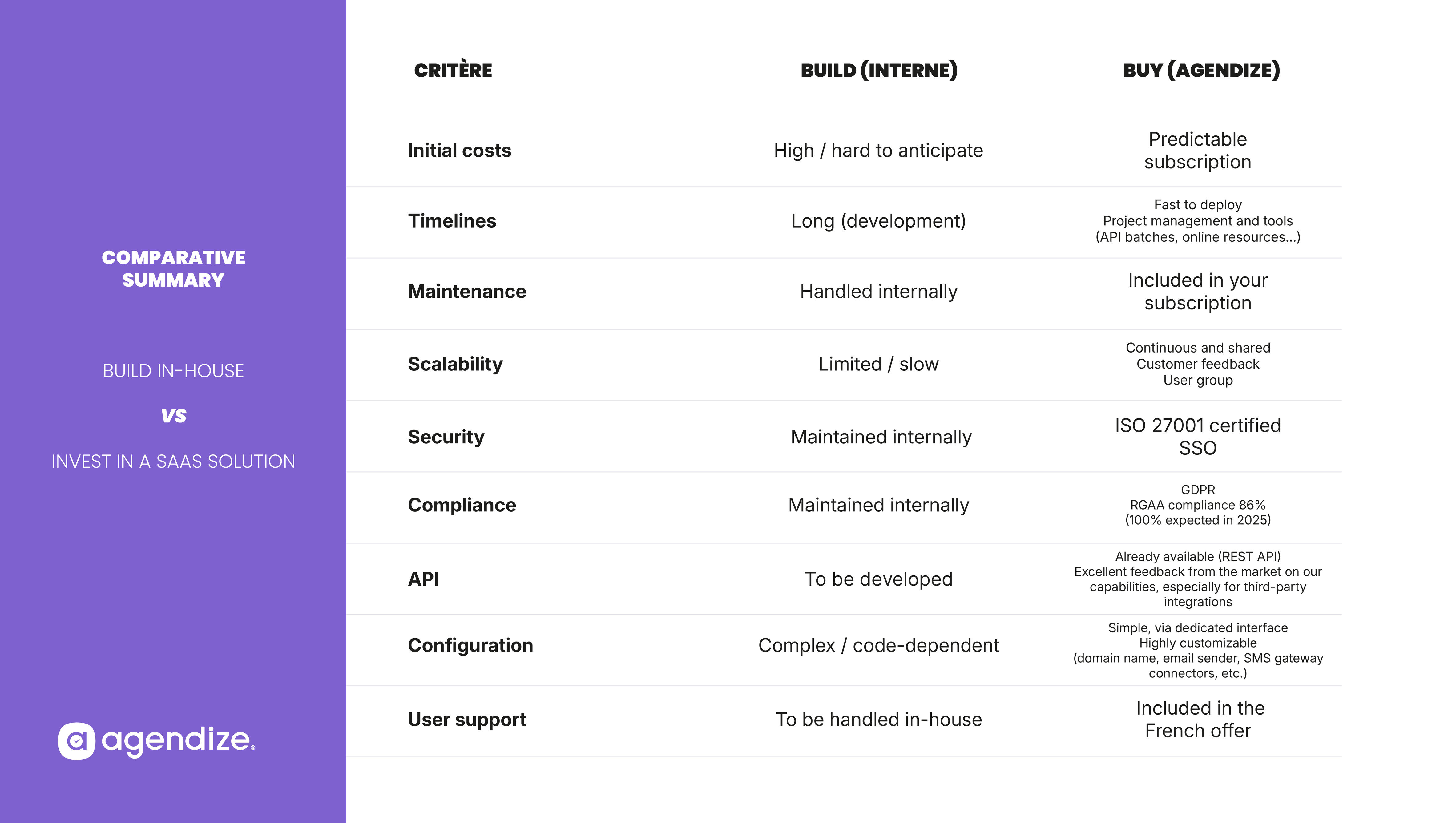
Are you hesitating between in-house development and a market solution? It may be useful to compare your hypotheses with an objective benchmark, or to talk to experts who have managed this type of project in environments similar to yours. The right choice rarely depends on a single criterion; it lies in the balance between control, efficiency, total cost and scalability.
Contact one of our experts to take advantage of Agendize expertise and find out more about the feasibility of your project.